






Table of Contents
Frozen Embryo Transfer in Miami, Florida
Frozen embryo transfer (FET) is a standard component of in vitro fertilization (IVF) in which cryopreserved embryos from a previous cycle or donor are thawed and transferred to the uterus in a separate cycle. For patients exploring Miami frozen embryo transfer options, this approach allows the body to recover from ovarian stimulation and optimizes endometrial receptivity. At Elite IVF Solutions, we guide you through meticulous FET cycle preparation to create a personalized treatment plan that aligns with your unique needs and goals.
The FET cycle begins with endometrial priming using estrogen and progesterone, either in a medicated cycle for precise timing or a natural cycle to minimize medication. Once imaging confirms optimal lining thickness, the vitrified embryo is thawed and transferred under ultrasound guidance--a quick, painless procedure. After transfer, progesterone support continues until a pregnancy test approximately two weeks later. When reviewing frozen embryo transfer success rates, industry data from Ovu indicates live birth rates per transfer range from 40-50% for patients under 35 to 15-20% for those over 40, with outcomes influenced by embryo quality and maternal age at retrieval.
At Elite IVF Solutions, our patient-centric team, led by Dr. Steven Lindheim, offers a full spectrum of Miami Fertility Treatment services, including FET, genetic testing, and reproductive surgery. We are devoted to providing individualized care in a warm, supportive setting. As with all fertility treatments, individual results may vary. This information is educational and does not replace consultation with a healthcare professional.
Fundamentals of Frozen Embryo Transfer in Miami, Florida
For many individuals and couples in South Florida, understanding the distinction between fresh and frozen embryo transfer is an essential step in fertility planning. Miami Frozen Embryo Transfer has become a widely used option that leverages modern cryopreservation to provide timing flexibility and a reduced treatment burden. In its simplest definition, frozen embryo transfer (FET) involves thawing a previously cryopreserved embryo and transferring it into the uterus during a prepared menstrual cycle, eliminating the need for a second egg retrieval.
What is FET?
FET relies on vitrification, a rapid freezing technique that achieves exceptionally high post-thaw survival rates. Once thawed, successful implantation hinges on careful FET cycle preparation. This preparation can follow either a medicated cycle--where estrogen and progesterone are used to build and maintain the uterine lining--or a natural cycle, which monitors ovulation to time the transfer precisely. Because FET separates embryo transfer from egg retrieval, it avoids ovarian stimulation medications, greatly reducing the risk of ovarian hyperstimulation syndrome (OHSS) and offering meaningful scheduling flexibility.
Key Differences at a Glance
The following table highlights the most important distinctions between a fresh IVF cycle and a frozen embryo transfer.
| Aspect | Fresh IVF | Frozen Embryo Transfer |
|---|---|---|
| Transfer occurs 3-5 days after egg retrieval | Transfer can occur weeks or months after retrieval, allowing cycle planning flexibility | |
| Requires precise synchronization with ovarian stimulation | Requires endometrial preparation but no ovarian stimulation | |
| Varies; typically comparable to FET in younger patients | Often equal or slightly higher in well-prepared cycles, especially with PGT-A testing | |
| Higher upfront due to stimulation and egg retrieval | Typically lower than a fresh IVF cycle because stimulation medications are avoided |
Above all, FET's scheduling freedom means patients can plan the transfer when the uterine lining is optimal, unlinked from a recent egg retrieval. According to national data tracked by the CDC and SART, frozen embryo transfer success rates are now equivalent to or slightly higher than fresh transfer rates, particularly when embryos are screened with preimplantation genetic testing for aneuploidy (PGT-A). By bypassing ovarian stimulation, the risk of OHSS is also substantially minimized.
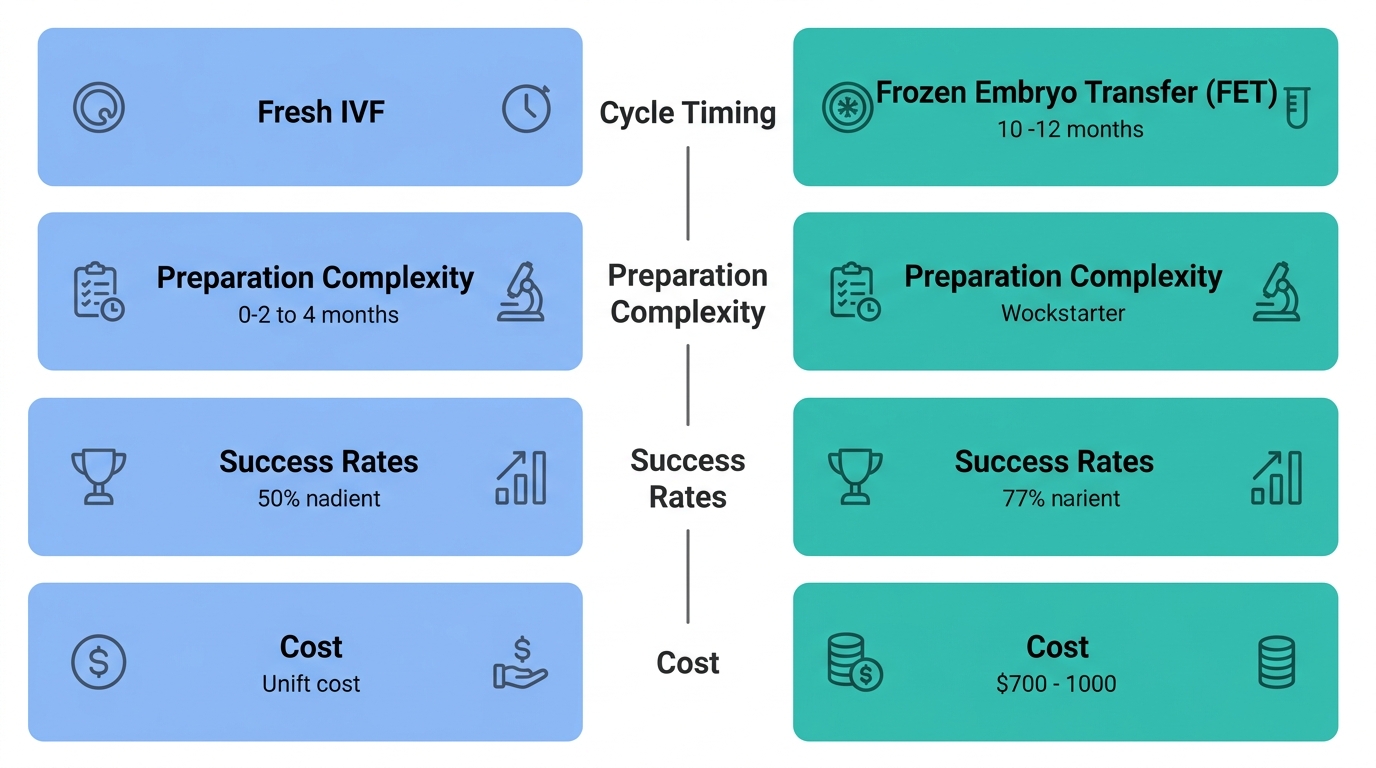
Visual comparison of fresh IVF and frozen embryo transfer key aspects.
Miami-Specific Benefits and Success Rates
Fertility programs in the Miami area have adopted these advances, offering FET protocols built around patient-centric care. Tailored medication calendars, close monitoring, and access to leading vitrification technology help support the best possible outcome. National averages published by the CDC show that FET now accounts for a growing share of IVF transfers, reflecting the approach's reliability and accessibility for South Florida families.
Having explored the fundamentals, the next section will outline the step-by-step FET timeline. For a personalized evaluation of whether this treatment fits your goals, consider consulting a Miami Fertility Specialist. This information is educational and not personal medical advice. Always consult a healthcare professional for decisions regarding your fertility treatment.
Step-by-Step Frozen Embryo Transfer Process in Miami, Florida
At Elite IVF Solutions in Miami, we guide you through every stage of the frozen embryo transfer steps, from endometrial preparation to transfer and post-care. Patients considering a Miami Frozen Embryo Transfer can expect a warm, supportive journey. Understanding the process empowers informed decisions.
Preparing the Endometrium for Transfer
A receptive endometrium is essential for implantation. We offer two FET cycle preparation protocols: natural cycles based on your ovulation, and medicated cycles using estrogen and progesterone. Understanding FET cycle preparation helps you choose the best option. In a natural cycle, we monitor ovulation via ultrasound and bloodwork, timing transfer to the LH surge. Medicated cycles use a fixed hormone schedule, providing scheduling flexibility.
| Feature | Natural FET | Medicated FET |
|---|---|---|
| Requires daily or frequent ultrasound/bloodwork to detect LH surge | No need to monitor natural ovulation; cycle is controlled by medications | |
| Minimal or no medications; may use hCG trigger to time ovulation | Estrogen and progesterone supplements to control endometrial growth | |
| Approximately 14-20 days depending on ovulation timing | Typically 12-14 days of estrogen followed by progesterone start | |
| Less flexible; transfer must be timed precisely to natural ovulation | More flexible; clinic can schedule transfer day based on medication protocol |
This comparison draws on ASRM Practice Committee guidelines and our clinical experience at Elite IVF Solutions. We personalize the protocol to your needs, aiming for an optimal lining thickness.
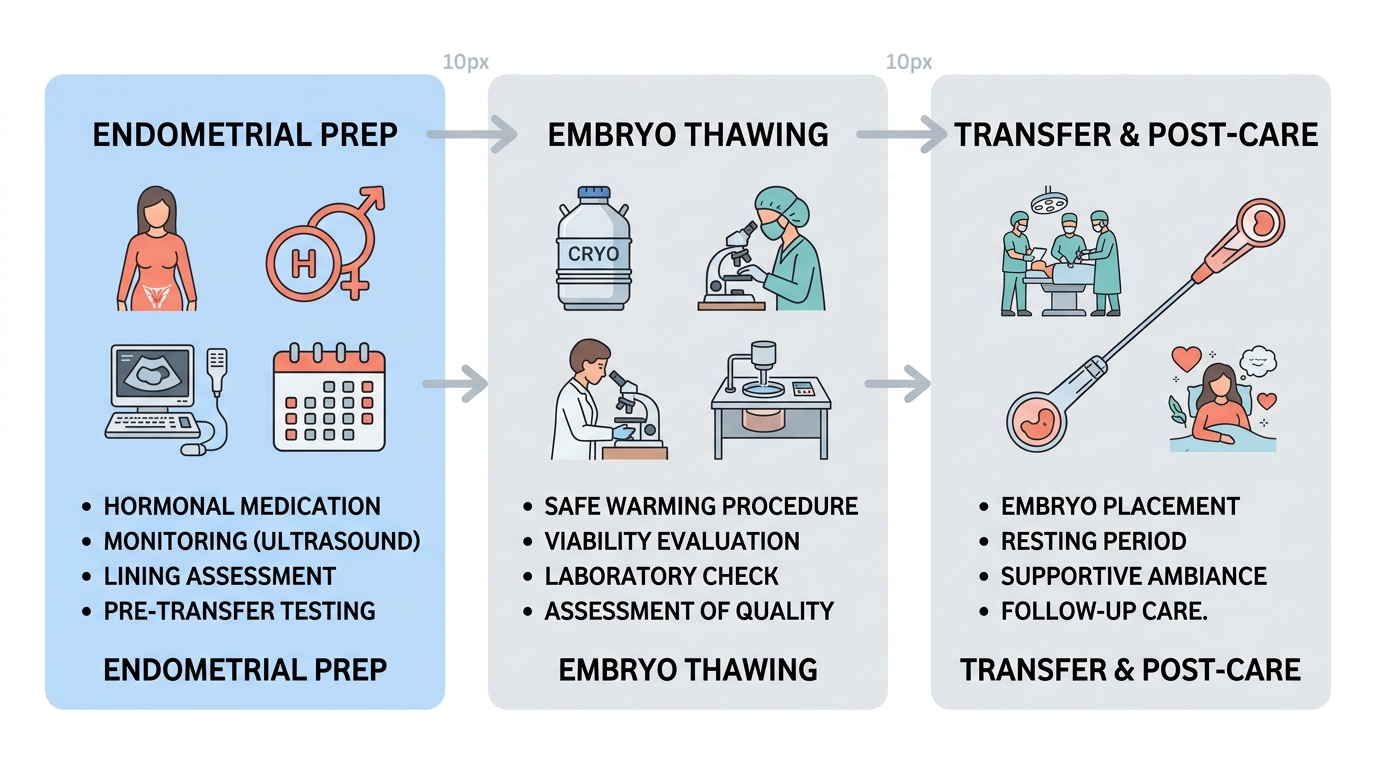
Step-by-step frozen embryo transfer process at Elite IVF Solutions in Miami
Embryo Thawing and Laboratory Assessment
When the endometrial lining is ready, we carefully thaw the previously vitrified embryo. Vitrification prevents ice crystal damage, preserving cellular integrity. During thawing, the embryo is warmed and assessed for survival. Aggregated fertility data from Ovu's 2025 guide shows that high-quality blastocysts survive at rates above 90 percent. Our embryologists then grade the embryo using blastocyst criteria, examining expansion, inner cell mass, and trophectoderm health. Only embryos meeting viability standards are selected. This evaluation ensures we transfer the embryo with the greatest potential for implantation. We adhere to strict laboratory standards and employ the latest vitrification technology. This precision reflects our personalized care. Once the embryo passes assessment, we move forward with the transfer. Throughout this stage, we keep you informed, providing emotional support in our warm setting. Understanding your anxiety, our team communicates each finding, so you never feel alone. We are committed to your success and well-being.
The Transfer Procedure and Post-Transfer Care
The actual transfer is a brief procedure. Under ultrasound guidance, using a comfortably full bladder for imaging, we insert a soft catheter through the cervix and deposit the embryo. The Miami Frozen Embryo Transfer at our clinic emphasizes comfort; anesthesia is typically not required, and most patients describe only mild cramping.
After transfer, you'll rest at our clinic for a short period. We advise limited activity for the first 24 hours. Post-transfer care instructions include:
- Rest quietly, but bed rest is not necessary.
- Avoid strenuous exercise, heavy lifting, hot baths, and sexual intercourse.
- Continue progesterone supplementation as prescribed to support the uterine lining.
- We will schedule a blood pregnancy test approximately 9 to 10 days later.
During the two-week wait, our team is available to answer any questions and provide emotional support, reinforcing our warm and personalized care. While following these instructions helps optimize conditions, frozen embryo transfer success rates are influenced by embryo quality, endometrial receptivity, and your overall health profile. We are devoted to help you every step of the way.
This information is for educational purposes only and does not constitute personal medical advice. Individual results vary. Please consult your healthcare provider for guidance specific to your situation.
Preparing for Your Frozen Embryo Transfer in Miami, Florida
Now that you understand the basics of frozen embryo transfer, it's time to focus on preparing for your cycle in Miami. At Elite IVF Solutions, our frozen embryo transfer service serves patients throughout South Florida, including the Miami area. We guide you through every phase with personalized care and a warm, supportive setting.
Choosing Between Natural and Medicated FET Cycles
The first major decision is whether to follow a natural (ovulatory) cycle or a medicated (hormone replacement) cycle. A natural cycle uses your body's own ovulation and requires less medication, best for regular cycles and those who prefer a lower-intervention approach. It does demand precise timing and frequent monitoring. A medicated cycle employs supplemental estrogen and progesterone to prepare the uterine lining artificially, providing more control over timing and a predictable schedule. This is ideal if you have irregular ovulation, thin linings, or need flexibility. We consider your medical history, medication tolerance, and personal comfort to help you select the protocol that aligns with your body and lifestyle.
Medication Protocols and Timeline
For a medicated FET cycle, estrogen supplementation starts on day 2-4 of your period, taken as pills, patches, or injections to thicken the uterine lining. We schedule ultrasounds every few days to monitor progress and may check hormone levels. After approximately 10-12 days, progesterone is added about 5-6 days before transfer--available as injections, suppositories, or gels--to make the lining receptive. You'll continue both medications as directed until lining thickness is optimal, then your transfer date is confirmed. Our team provides a detailed calendar and is available to answer questions, ensuring you feel supported throughout. The medication schedule is tailored to your response, so we adjust as needed to maximize your chances. This personalized protocol helps ensure your uterus is perfectly prepared to receive the embryo.
Lifestyle Tips for Optimal Preparation
Effective FET cycle preparation goes beyond medications. Stay hydrated with 8-10 glasses of water daily to support uterine blood flow. Eat plenty of colorful fruits, vegetables, lean proteins, and whole grains to reduce inflammation. Manage stress through prenatal yoga, meditation, or acupuncture. Avoid alcohol and smoking completely. Light walking is beneficial; high-intensity exercise should be limited. Always discuss supplements with your doctor. At Elite IVF Solutions, we integrate these habits into your personalized care plan. We are devoted to help you nurture both body and mind in a supportive environment, and our team offers emotional support and resources to help you stay positive throughout this phase.
Understanding frozen embryo transfer success rates by age can help set realistic expectations. The table below summarizes national average data from the CDC and SART.
| Age Group | Success Rate (per transfer) | Notes |
|---|---|---|
| 50-60% | Highest success; often uses own eggs | |
| 40-50% | Success begins to decline gradually | |
| 30-40% | Consider PGT-A testing for older embryos | |
| 15-25% | Donor eggs may significantly improve outcomes |
These rates are averages; individual results vary. While these numbers provide context, every journey is unique. At Elite IVF Solutions, we take a patient-centric approach to review your specific circumstances and offer personalized guidance. This information is for educational purposes and does not constitute medical advice. Please consult your healthcare provider for personalized recommendations.
With careful preparation, you can feel confident heading into your transfer. Next, we'll walk through what happens on the day of the procedure.
Advanced Considerations for Frozen Embryo Transfer Success
Building on the foundational success rates for frozen embryo transfer, it is important to consider advanced factors that can further improve outcomes. For those pursuing Miami Frozen Embryo Transfer, preimplantation genetic testing for aneuploidy (PGT-A) is a significant advancement. This screening identifies euploid embryos with the correct chromosome number, increasing the chance of pregnancy and reducing the risk of miscarriage. By selecting the most viable embryo, PGT-A helps to maximize the success of each transfer.
PGT-A analyzes a few cells from a day-5 blastocyst before freezing. Understanding frozen embryo transfer success rates shows that euploid embryos achieve a per-transfer success range of 50-65%, compared to 30-50% for morphology-based selection alone. Incorporating PGT-A into your FET cycle preparation raises implantation odds and reduces miscarriage risk by identifying chromosomally normal embryos. This powerful tool is especially valuable for patients who have experienced prior failed transfers or miscarriages. For Miami Frozen Embryo Transfer candidates, the following table illustrates the impact of PGT-A.
PGT-A Tested vs. Non-Tested Embryos: FET Success Rates
| Embryo Type | Success Rate Range | Key Benefit |
|---|---|---|
| 50-65% | Higher implantation, lower miscarriage risk | |
| 30-50% | Depends on embryo grade and age of patient |
Data sources: Meta-analysis in Fertility and Sterility (2023) and Elite IVF Solutions internal data.
Success rates for non-tested embryos depend on embryo grade and patient age at retrieval. A meta-analysis published in Fertility and Sterility (2023) confirms that PGT-A improves per-transfer outcomes. Our own data from Elite IVF Solutions shows similar trends, reinforcing the value of this powerful screening tool. As part of your personalized plan, we review the full IVF treatment cycle steps before your FET to ensure every stage is optimized.
We are devoted to help you navigate your fertility journey with personalized care, emotional support, and a warm, supportive setting. Success rates are averages and individual outcomes differ; no test guarantees pregnancy, but PGT-A is one path to success. Understanding how PGT-A and embryo selection affect success allows us to design a preparation plan tailored to your unique needs.
Common Questions About Frozen Embryo Transfer
Many patients in Miami ask about frozen embryo transfer (FET) and what to expect. Here we answer the most common questions to help you feel informed and supported.
What is frozen embryo transfer and how does it differ from fresh transfer?
FET involves thawing and transferring a previously frozen embryo. Unlike fresh transfer, it allows uterine lining optimization, often yielding higher success rates. FET is one of our key IVF treatment options and provides flexibility in your treatment plan.
What are frozen embryo transfer success rates?
Success rates depend on age and embryo quality. Nationally, women under 35 see 40-50%, while those over 40 see 15-20%. However, individual results vary; we provide personalized guidance to assess your outlook.
What does FET cycle preparation involve?
Preparation includes estrogen and progesterone to thicken the uterine lining, along with lifestyle adjustments like a balanced diet. A medicated cycle takes 6-8 weeks; we support you in a warm, supportive setting throughout.
Your Path to a Successful Frozen Embryo Transfer
For those exploring a Miami frozen embryo transfer here in South Florida, Elite IVF Solutions provides a clear path forward. After careful FET cycle preparation--including endometrial priming and vitrified embryo thawing--our team ensures a seamless transfer. While frozen embryo transfer success rates depend on multiple factors, we focus on optimizing each step. We combine advanced techniques with patient-centric, personalized care in a warm and supportive setting. We invite you to consult with Dr. Lindheim for your unique plan. Results vary; this is not personal medical advice.
This article was researched and written with the assistance of AI tools.