






Table of Contents
Understanding How Exercise Affects Fertility and IVF Success
Excessive exercise can affect fertility in women because extreme physical activity disrupts ovulatory function and hormonal balance, often leading to menstrual irregularities and reduced chances of conception. Female infertility affects approximately 15% of couples globally, about one in six, with female factors accounting for 35–50% of cases; ovulatory disorders and unexplained infertility each contribute up to 30% of those cases. At Elite IVF Solutions, we educate patients that extreme exercise is a documented lifestyle contributor to these challenges, and we offer personalized exercise guidance as part of our comprehensive care. While regular moderate exercise supports overall wellness, researchers have shown that overexertion can interfere with the hormonal interplay necessary for successful IVF cycles. Understanding this balance is critical for anyone trying to conceive or preparing for IVF, and we now explore the scientific reasons why excessive exercise can backfire.
The Science Behind Exercise and Fertility: When Too Much Exercise Backfires
For those wondering whether excessive exercise can affect fertility, research points to a clear threshold between benefit and harm. Physical activity’s impact on reproductive health is dose-dependent, moderate-intensity movement helps maintain hormonal balance and ovulatory cycles, but when exercise intensity and volume exceed a limit, the body can shift from a pro-fertility state to one that impedes conception.
When exercise demand becomes chronic and excessive, the body perceives a state of stress, and we observe cortisol surges that can suppress the pulsatile release of gonadotropin-releasing hormone (GnRH) from the hypothalamus. With reduced GnRH stimulation, the pituitary gland decreases its secretion of luteinizing hormone (LH) and follicle-stimulating hormone (FSH)—the two gonadotropins that drive follicle maturation and ovulation. Insufficient FSH halts follicular development, while the loss of the mid-cycle LH surge prevents the egg from being released. In our clinical experience, the energy deficit that commonly accompanies intense training lowers leptin levels, a hormone produced by adipose tissue that normally activates kisspeptin neurons to stimulate GnRH output. Without that activation, the reproductive axis downregulates further, resulting in amenorrhea and anovulatory cycles.
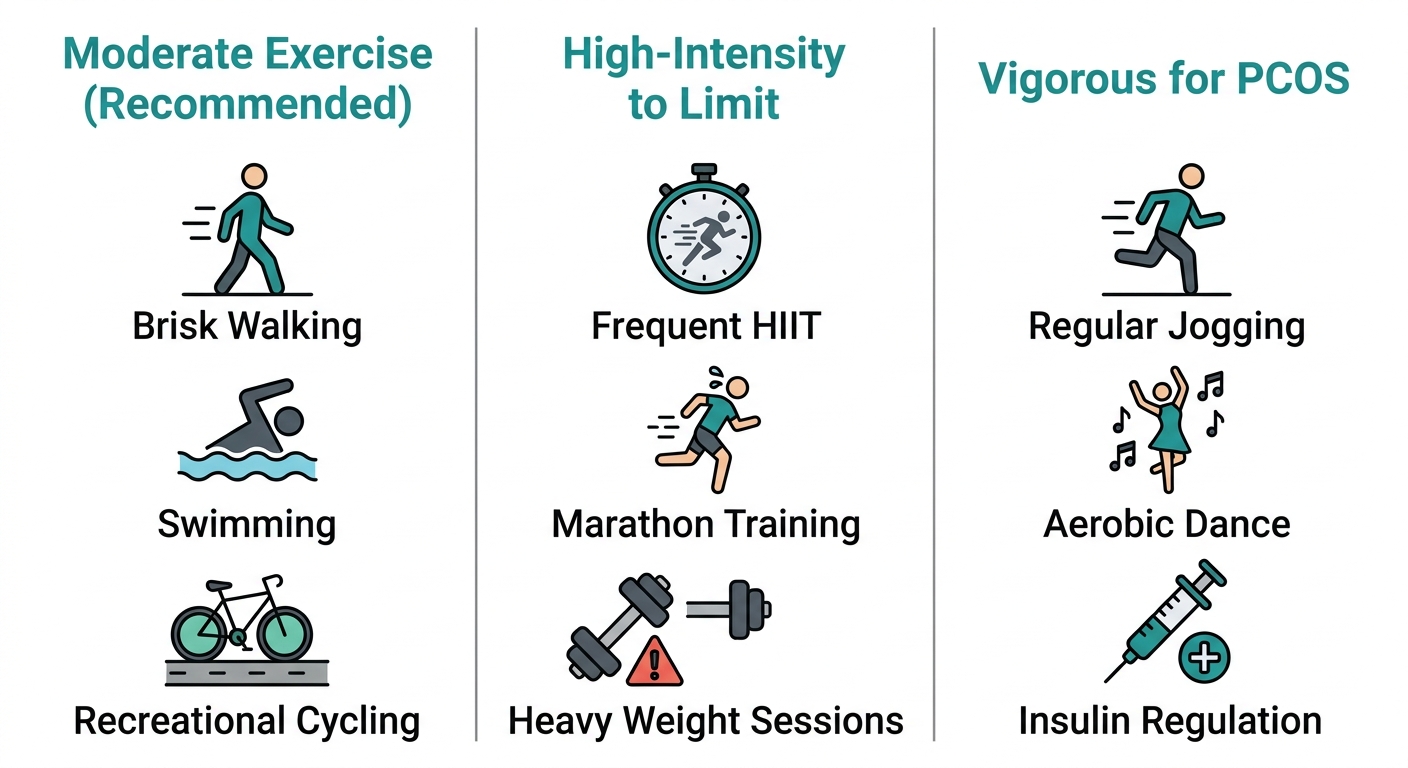
Published in February 2025 by the Fertility Friends Foundation, this educational article discusses the dose-dependent relationship between exercise intensity and fertility. The data shows that women who partake in regular, vigorous exercise are up to 1.5 times more likely to have subfertility issues compared to those engaging only in moderate levels of physical activity. On the other hand, moderate-intensity exercises like brisk walking, swimming or cycling at a conversational pace help maintain good ovulation health by decreasing inflammatory responses and improving insulin sensitivity without triggering the detrimental stress-hormone cascade.
However, for women with polycystic ovary syndrome (PCOS), vigorous exercise takes on a therapeutic role, and we tailor our recommendations accordingly. Because insulin resistance and hyperandrogenism lie at the core of PCOS, higher-intensity activity—such as 30 minutes of aerobic exercise three times weekly plus resistance training—can improve insulin sensitivity and reduce androgen levels, supporting more regular ovulation.
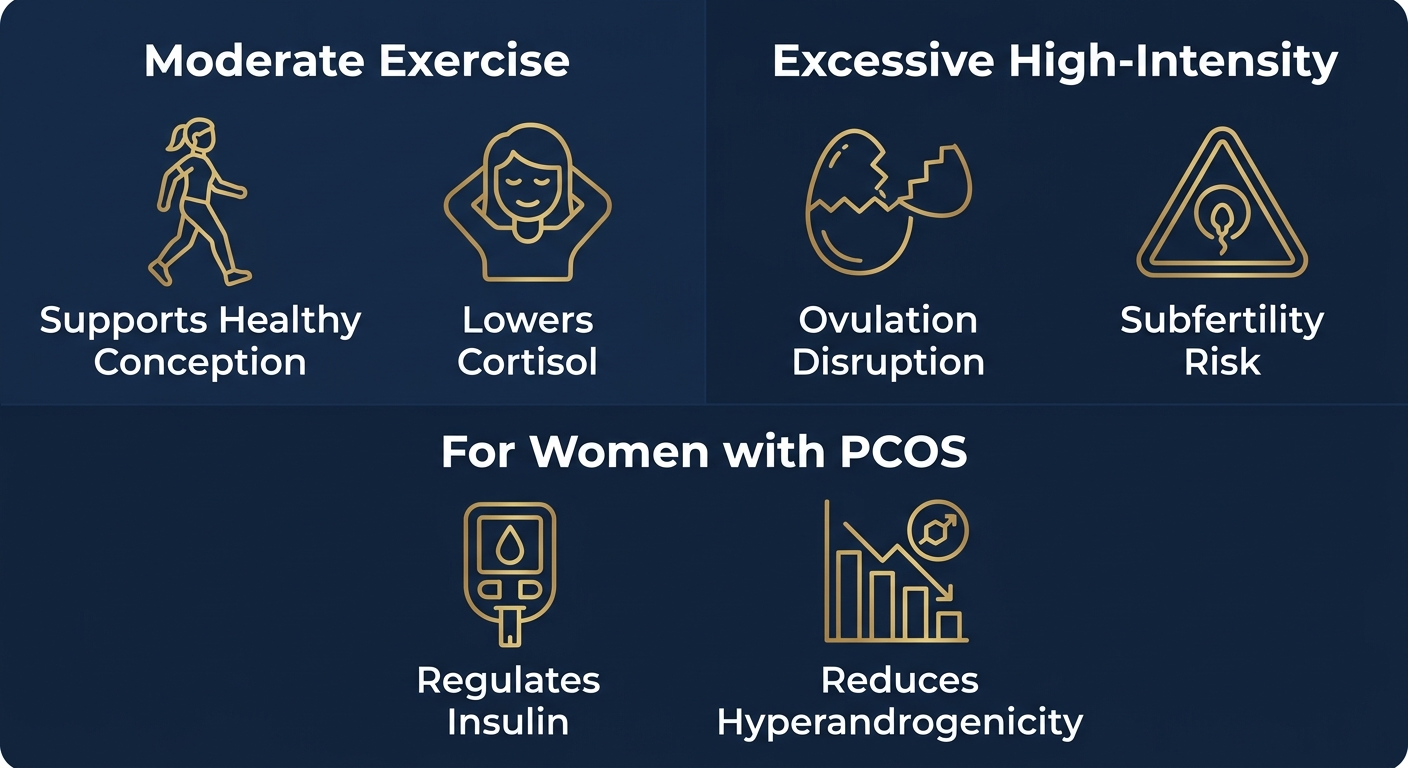
Recognizing where that line lies between helpful and harmful activity lets us steer clear of fitness programmes that would hinder a patient’s fertility goals and instead recommend fitness plans that support them.
How High-Intensity Exercise Disrupts Ovulation and Menstrual Cycles
Can excessive exercise affect fertility? While moderate activity provides hormone-balancing benefits, high-intensity training can disrupt ovulation and menstrual cycles. We understand that every individual’s body responds differently, but research shows that frequent, strenuous workouts may tip the balance away from reproductive health.
Moderate activity like walking briskly, cycling or swimming has been linked with improved insulin sensitivity, lowered cortisol level and increased regularity of ovulation. High intensity exercise such as long runs, heavy CrossFit training or extreme endurance exercise may lead to suppression of the hypothalamic-pituitary-ovarian axis, which can result in anovulation or irregular or absent menses. According to educational resources on exercise and fertility, women who engage in frequent, high-intensity exercise are up to 1.5 times more likely to experience subfertility compared to those who maintain moderate activity levels.
The impact differs by exercise type:
- Moderate activity promotes hormone balance and lowers stress-related cortisol.
- High-intensity training can disrupt ovulation by altering energy balance and hormonal signaling.
Can too much exercise affect ovulation? Yes, through several mechanisms. Extreme physical activity is documented as a contributor to reduced fertility, and it is cited among lifestyle factors that negatively impact reproductive potential, as noted by Elite IVF Solutions. This disruption often manifests as ovulatory disorders, which account for 25–30% of female infertility cases, and may also contribute to unexplained infertility, representing 15–30% of diagnoses. The body’s energy balance plays a key role: when energy expenditure consistently exceeds intake, the brain may downregulate reproductive hormones, pausing ovulation as a protective response.
Notably, the relationship between exercise and fertility is not one-size-fits-all. For women with polycystic ovary syndrome (PCOS), vigorous exercise—especially resistance training—can improve insulin sensitivity and reduce hyperandrogenism, supporting more regular ovulation. Women taking part in a 20 week aerobic fitness programme saw significant improvements to their insulin resistance and fasted blood sugar levels. Patients with PCOS need to have their activity plans designed in consultation with providers who understand their needs.
High-intensity training changes a complex hormone balance that causes eggs to mature in a woman’s ovaries, thus helping us understand what warning signals might show up when women train too intensely for their bodies.
Recognizing the Signs That Your Workout Routine May Be Affecting Fertility
When a woman engages in prolonged, high-intensity workouts, subtle changes in her menstrual cycle may be the first signal that her body is under reproductive stress. While moderate exercise is known to support hormonal balance and overall reproductive health, it is the extremes, particularly high-intensity, long-duration activity without adequate recovery, that are more likely to disrupt the delicate cascade of signals that govern ovulation. The hormonal disruptions caused by excessive training can quiet the signals that normally trigger ovulation, and for many women, the earliest clues appear in patterns they can track at home.
Irregular or missed periods are often the most noticeable sign. Women may experience lighter cycles, longer intervals between periods, or, in more pronounced cases, amenorrhea, which is the absence of menstruation for three or more months. Even if a period arrives, ovulation may not be occurring, a condition known as anovulation that can be confirmed through ovulation predictor kits or basal body temperature charting. A 2025 educational article from the Fertility Friends Foundation notes that women who participate in frequent, high-intensity exercise are up to 1.5 times more likely to experience difficulty conceiving compared to those who exercise moderately. This statistic highlights the importance of recognizing when an otherwise healthy habit may be tipping into a fertility-compromising pattern.
Importantly, the relationship between exercise and fertility is not uniform. For women with Polycystic Ovary Syndrome (PCOS), regular vigorous activity and resistance training can improve insulin sensitivity, reduce androgen levels, and support more predictable ovulation. Exercise, in these cases, becomes a therapeutic tool rather than a risk factor. If you are noticing any of these signs or managing PCOS, we encourage you to seek a professional evaluation. Our team provides personalized care, including Nutrition and Exercise guidance as part of a comprehensive fertility care plan, helping you calibrate physical activity to your specific reproductive needs.
We also can’t forget about men. Research has shown that excessive exercise might harm sperm quality. As we know, this means both partners need to be on a more moderate level in their activity levels.
Does Excessive Exercise Affect Male Fertility? Sperm Count and Quality Concerns
Our patients often ask, can excessive exercise affect fertility? With fertility, the relationship between physical activity and reproductive health is not a simple one. To know whether excessive exercise can affect male fertility is to know the complex interplay of hormonal dynamics. While women more often receive guidance about the impact of intense training on their cycles, male partners frequently wonder whether their own workout habits might be affecting sperm count and quality.
When does excessive exercise affect sperm count? The current body of peer-reviewed research does not offer a clear, quantified answer. Most available studies that examine exercise and fertility focus on female reproductive outcomes. General health resources, including an educational website about exercise intensity levels, note that moderate activity supports hormonal balance while frequent high-intensity workouts have been associated with subfertility in women; however, these findings cannot be directly applied to male fertility. The limited studies that do exist on male endpoints offer mixed signals, with no consensus on a specific activity threshold that impairs semen parameters. This gap in the literature makes it impossible to provide a one-size-fits-all exercise prescription for men concerned about their fertility.
Because each person’s physiology, training history, and medical background are unique, the effect of exercise on male fertility varies widely. We consider factors such as overall health, body composition, training intensity, and any underlying conditions when evaluating a male patient’s fertility potential. Our team reviews the full picture—including lifestyle and workout routines—to determine whether adjustments might support your reproductive goals. In our warm and supportive setting, we ensure that this evaluation is thorough and compassionate.
We invite you to meet with a fertility specialist at Elite IVF Solutions for a personalized assessment. Since no two fertility journeys are the same, professional guidance is essential to understand how your specific exercise habits may influence your reproductive health. In the next section, we offer recommended exercise guidelines that support fertility and IVF outcomes, complementing the individualized medical advice you receive during your consultation.
Recommended Exercise Guidelines to Support Fertility and IVF Outcomes
Physical activity influences reproductive health through effects on hormonal balance, insulin sensitivity, and stress regulation. For women trying to conceive, exercise type and intensity matter as much as consistency. We emphasize evidence-based guidelines to support natural fertility during family-building efforts.
Healthy women benefit most from exercising at moderate intensity. Such activities as brisk walking, recreational biking, and swimming can support ovulation but avoid the hormonal complications caused by too much exercise. On the other hand, high-intensity activity every day leaves a woman’s body near maximum effort and could result in fertility problems. Studies show that women who exercise frequently at intense levels may have up to 1.5 times the risk of subfertility compared to women who exercise moderately. Exercise may affect ovulatory function if there is enough physical stress placed upon the body that the body cannot produce mature eggs each month.
Women who have polycystic ovary syndrome should follow a slightly different set of suggestions when embarking on an exercise routine for health improvement. For those suffering from this condition, vigorous exercise appears more beneficial to help control underlying metabolic problems. Thus, women following a vigorous aerobic training program that involves about 30 minutes three days a week along with some form of resistance training can benefit greatly by improving insulin resistance and reducing hyperandrogenicity. Evidence exists showing that a regular exercise schedule like this may lead to decreases in fasting blood-glucose levels as well as markers indicating increased inflammation in affected women. These metabolic improvements would be highly meaningful because insulin resistance commonly interferes with ovulatory function. Other benefits usually don’t come simply from losing weight and so people of many different body types also should gain advantages to health by getting some kind of consistent activity going.
Working out reduces stress too, another aspect that affects fertility. Exercise helps lower the body’s amount of cortisol, which is valuable because chronic stress and high cortisol can disrupt the menstrual cycle and interfere with conception. Getting physical may support both emotional well-being and reproductive function.
We provide personalized exercise guidance as part of our comprehensive care in South Florida. At our clinic, we help you balance activity with your treatment plan so your lifestyle supports your path to parenthood
Balancing Physical Activity for Your Fertility Goals with Elite IVF Solutions
The question of whether excessive exercise can affect fertility is central to how we help patients align physical activity with their reproductive goals. Research indicates that moderate-intensity exercise supports hormonal balance in women trying to conceive, while frequent high-intensity training is linked to a higher likelihood of subfertility. The key is individualization—what works for one person may be less beneficial for another depending on underlying conditions. For those with PCOS, however, vigorous exercise plays a valuable role by improving insulin sensitivity and reducing androgen levels. With these evidence-based distinctions in mind, we encourage you to meet with our team to tailor an exercise approach that fits your unique needs. Results vary by individual, and this information is educational—not a replacement for professional medical advice. To explore comprehensive fertility care in Weston and South Florida, reach out to schedule your consultation.
Get Personalized Fertility Exercise Guidance
You have learned how balancing exercise is crucial for fertility and IVF outcomes. The guide above explained that moderate activity supports reproductive health while excessive high-intensity training can hinder it. Now it's time to apply these insights to your own journey with a plan tailored to your unique needs. We provide personalized nutrition and exercise counseling designed to optimize your fertility. Our specialists will work with you to create a safe, effective regimen that aligns with your treatment goals. Whether you're managing PCOS or simply seeking a healthy balance, we offer evidence-based strategies. Take the next step and schedule a consultation to achieve your fertility goals with expert support.
Get Personalized Fertility Exercise Guidance