
















Table of Contents
How to Check Egg Supply: A Comprehensive Guide
If you're wondering how to check egg supply, understanding ovarian reserve testing is a crucial first step. This medical evaluation estimates a woman's remaining egg quantity through three common tests: the anti-Müllerian hormone (AMH) blood test, which can be drawn on any day of the cycle; the follicle-stimulating hormone (FSH) test, measured on cycle days 2–5; and the antral follicle count, a transvaginal ultrasound that counts small follicles in the ovaries. According to the Society for Assisted Reproductive Technology (SART), these tests help fertility specialists predict how the ovaries will respond to stimulation medications and guide treatment planning, though they do not guarantee a specific outcome.
At Elite IVF Solutions, every fertility assessment begins with ovarian reserve tests that give us critical information about you in order to develop a treatment plan for each patient. Before moving forward with testing, it is important to understand what factors can affect your results and how best to prepare.
Essential Information Before Checking Your Egg Supply
In order to assess ovarian reserve, several health assessments and diagnostic examinations are conducted prior to ovarian reserve testing according to Society for Assisted Reproductive Technology guidelines (SART). This information will help to ensure your optimum health and reproductive potential.
You should optimize your entire health state, which involves managing chronic diseases like diabetes, hypertension, or asthma as well as staying at a normal weight. This is due to the fact that underlying health issues may affect fertility in addition to the results of IVF.
The two primary blood markers used in ovarian reserve testing are: Anti-Müllerian Hormone (AMH), which can be measured anytime during your menstrual cycle, and FSH, which should be drawn between days 2 & 5 of your period to obtain reliable results. The Antral Follicle Count, measured via Ultrasound, gives us another way of assessing your ovarian reserve.
Genetic carrier screening is included in this step to determine any heredity risks and to ensure patients have full information on what’s about to happen during treatment. A uterine evaluation—often using saline infusion sonohysterography or hysteroscopy—rules out structural issues that could interfere with implantation.
We review all of these baseline findings during your initial consultation, where we personalize your care plan and determine the most appropriate next steps.
Once these fundamentals are established, you will be able to continue on to your next step, which is having a meeting with a fertility specialist for the start of your personal plan.
Step 1: Schedule a Consultation with a Fertility Specialist
In order to begin measuring the size of your ovarian reserve, you will have your first appointment with us at Elite IVF Solutions. In this initial visit we go over your medical history, talk about what kind of children you want to have, and then explain the different tests that need to be done, such as blood tests and transvaginal ultrasound.
- Location: Our clinic is at 1609 Town Center Circle in Weston, FL, conveniently serving patients from Miami, Fort Lauderdale, and throughout South Florida.
- Hours: Consultations are available Monday through Friday, 8:00 AM to 5:00 PM, with monitoring appointments also offered on Saturdays and Sundays for your convenience.
Give us a call at 954-999-5955 or shoot us an email at info@eliteivfsolutions.com and we'll walk you through setting up that first appointment.
During your consultation, your specialist may discuss hormone testing that offers valuable insight into your egg supply and helps determine the most appropriate next steps in your fertility journey. This may include anti-Müllerian hormone (AMH).
Step 2: Understand the Role of AMH in Egg Supply
Anti-Müllerian Hormone (AMH) is a hormone produced by ovarian follicles and serves as the blood test for assessing ovarian reserve. To understand how to check egg supply, it helps to understand AMH, as this test provides a reliable snapshot of your remaining egg count. Used together with antral follicle counts, AMH helps fertility specialists predict how you will respond to ovarian stimulation during IVF.
The AMH test is a simple blood draw. SART guidelines explain that unlike FSH, AMH levels remain consistent across the menstrual cycle, so the blood draw can be scheduled at any time, and that an AMH value below 1.0 ng/mL predicts a low response to stimulation. Nevertheless, AMH is just one part of a comprehensive evaluation. We interpret your AMH results as part of your personalized care, always considering your full medical history and fertility goals. With this foundational knowledge, the next step is to have your own AMH drawn.
Step 3: Get Your AMH Blood Test
The AMH blood test is a simple blood draw that requires no fasting or special preparation. Because AMH levels remain stable throughout your menstrual cycle, you can have this test on any day of the month—a convenience that sets it apart from other ovarian reserve markers like FSH, which is typically measured on cycle days 2–5. We can arrange this test in a warm and supportive setting, and we order it alongside an antral follicle count ultrasound and a day-3 FSH blood draw to provide a complete picture.
Your AMH results, combined with your FSH level and antral follicle count, offer a clearer picture of your ovarian reserve when your doctor interprets them. We guide you through what each result means, so you can make informed decisions about your fertility journey.
Step 4: Interpret Your AMH Test Results
Anti Müllerian Hormone (AMH) provides a consistent measure of ovarian reserve, indicating the number of eggs remaining in the ovaries. Because AMH levels remain stable throughout the menstrual cycle, the blood test can be performed on any day, unlike FSH which requires specific cycle timing.
According to guidelines from the Society for Assisted Reproductive Technology (SART), an AMH level below 1.0 ng/mL indicates a decreased likelihood of responding well to ovarian stimulation, which could translate to lower numbers of mature eggs being retrieved in vitro fertilization cycles. It should be understood, however, that AMH alone is not enough information on its own because other factors including FSH and antral follicle counts also need to be assessed when determining a patient’s ovarian reserve.
We recommend reviewing your AMH result with your fertility specialist, who will interpret it in the context of your full diagnostic workup and create a treatment plan.
An antral follicle tally is obtained from an ultrasonogram, adds critical insights, and when combined with AMH gives you and your physician a more complete understanding of your ovarian reserve.
Step 5: Assess Antral Follicle Count with an Ultrasound
After reviewing your AMH blood test results, the next component of your ovarian reserve evaluation is a transvaginal ultrasound to count your antral follicles. The antral follicle count (AFC) measures the small, resting follicles visible in your ovaries, which represent your current egg supply. Alongside AMH, AFC helps us gauge your likely response to ovarian stimulation. According to professional society guidelines from the Society for Assisted Reproductive Technology (SART), a low AFC is fewer than 5–7 follicles measuring 2–10 mm. AFC complements your AMH value by directly visualizing the ovarian follicles, ensuring a complete reserve estimate. The ultrasound is performed in our office and takes only a few minutes. You will lie comfortably on an exam table while we use a slender, lubricated probe to gently image your ovaries. The AFC result, combined with your AMH and the FSH and estradiol levels we will evaluate next, gives us a comprehensive picture of your ovarian reserve.
Step 6: Evaluate FSH and Estradiol Levels
Follicle-stimulating hormone (FSH), measured on cycle days 2-5 of the menstrual cycle, provides a key blood marker for evaluating egg supply. According to SART, FSH is also used in combination with AMH and AFC to evaluate ovarian reserve, as well as predict response to ovarian stimulation. It is preferable to obtain these two tests on cycle days 2-5 as this is the time when the ovaries are "resting" so to speak, providing the most accurate baseline. If FSH > 10IU/L then this suggests a decreased ovarian reserve.
The second test for estradiol, done on the same early cycle day as the other hormone, gives us another clue about what is happening in the ovaries. An elevated estradiol value can lower your FSH result, and so these two results are considered together when deciding how the ovaries are working. A normal estradiol level typically falls below 60–80 pg/mL, and values above this threshold may indicate decreased ovarian reserve.
FSH plus estradiol, together with AMH and follicles, form the basis for the ovarian reserve assessment used to determine the plan for your fertility treatment.
Step 7: Combine Results for a Comprehensive Fertility Assessment
Understanding how to check egg supply involves combining several test results into a comprehensive assessment. We interpret AMH levels together with FSH, estradiol, and the antral follicle count. When basal estradiol is below 60–80 pg/mL, it supports accurate FSH interpretation. A low AMH (below 1.0 ng/mL) combined with elevated FSH (above 10 IU/L) and a low antral follicle count (fewer than 5–7 measurable follicles) can suggest diminished reserve and reduced response to stimulation.
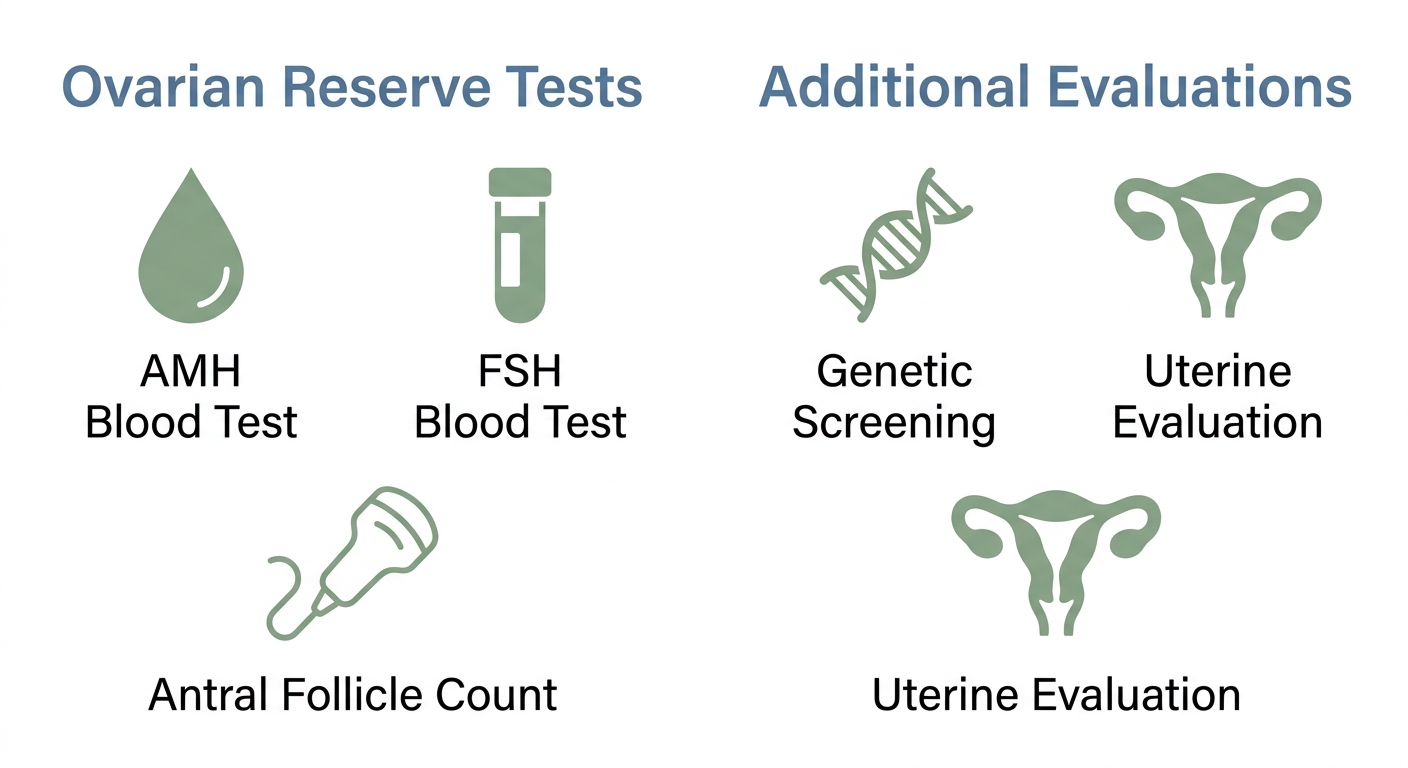
In addition to standard tests, an in-depth pre-assessment examines genetic carrier status and evaluates the uterus to identify heritable conditions and structural challenges that affect implantation and pregnancy. Once all information has been evaluated, you’ll be able to discuss any further questions you have with regard to the whole testing experience.
Addressing Common Fertility Testing Concerns
Many patients wonder whether fertility tests require specific timing. At our practice, we follow the evidence-based guidelines from the Society for Assisted Reproductive Technology (SART).
Concern: Can I have my AMH level checked at any point during my cycle?
Yes. SART notes that Anti-Müllerian Hormone (AMH) levels remain stable throughout the menstrual cycle, so you can have your blood drawn any day without needing to schedule around a specific cycle phase.
Concern: Why does FSH need to be drawn on specific cycle days?
Follicle-stimulating hormone (FSH) fluctuates during the menstrual cycle, so SART guidelines recommend measuring it between cycle days 2 and 5. This timing yields a baseline value that helps predict how your ovaries may respond to stimulation.
Concern: What does a low AMH mean for my IVF treatment?
An AMH level below 1.0 ng/mL is associated with a lower response to ovarian stimulation. However, this result does not determine whether you can achieve a pregnancy; it simply helps your care team tailor a protocol that optimizes your chances.
Concern: Is genetic carrier screening necessary before IVF?
SART recommends preconception genetic carrier screening for all patients. This blood test identifies whether you and your partner carry genes for certain hereditary conditions, allowing you to make informed decisions.
Concern: How is my uterus evaluated and why is it important?
A thorough uterine evaluation—which may include saline infusion sonohysterography, hysteroscopy, or a mock embryo transfer—rules out structural issues like polyps or scarring that could interfere with embryo implantation.
Once all the issues have been resolved, you're finally able to take action on your plan for assessing fertility.
Your Next Steps for Fertility Assessment
Understanding how to check your egg supply begins with a comprehensive fertility assessment.
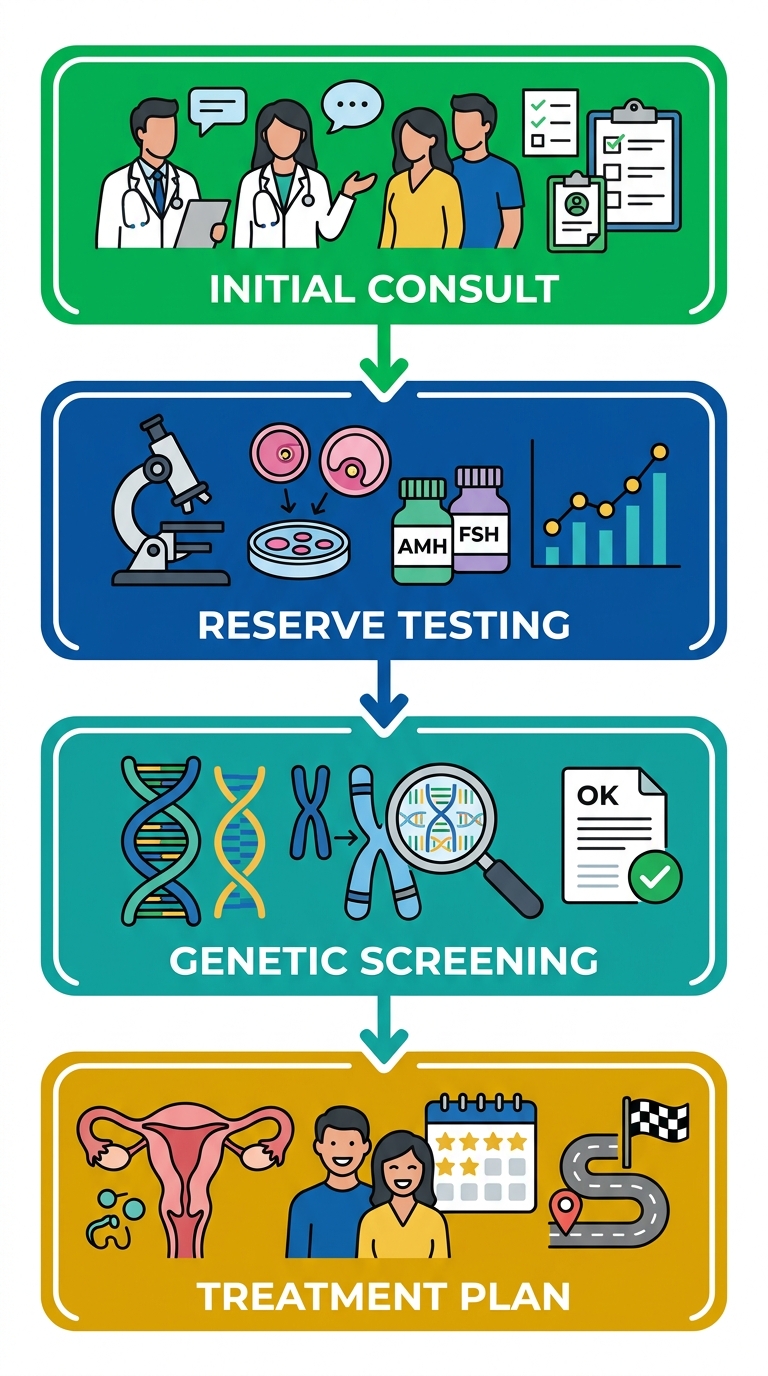
Concrete steps in your fertility assessment include:
- Prioritizing preconception health by managing chronic conditions and optimizing weight.
- Completing ovarian reserve testing, including anti-Mullerian hormone (AMH), follicle-stimulating hormone (FSH) on cycle days 2 through 5, and transvaginal ultrasound to count antral follicles.
- Undergoing genetic carrier screening to identify hereditary conditions that may affect your treatment plan or your future child’s health.
- Receiving a uterine evaluation to assess the uterine cavity for structural factors that could impact embryo implantation.
Individuals' responses may differ from those described here due to different health statuses. This content should be used for informational purposes only and not as personal medical guidance.
We invite you to schedule a consultation at our Weston office.
Start Your Fertility Assessment Today
Now that you understand how ovarian reserve testing—through AMH, antral follicle count, and FSH levels—provides a comprehensive picture of egg supply, the next step is to put that knowledge into action. Scheduling a consultation with a fertility specialist at our clinic allows you to receive personalized guidance on your fertility assessment. Our clinic is conveniently located in Weston, Florida and welcomes patients from throughout South Florida, including Miami and Fort Lauderdale. We offer consultations Monday through Friday from 8:00 AM to 5:00 PM, with weekend monitoring appointments also available. Call us at 954-999-5955 or use the link below to book your initial evaluation. Taking this step can bring clarity to your reproductive health and help you plan for the future.
Start Your Fertility Assessment Today