















Table of Contents
Understanding Genetic Testing for IVF in Miami, Florida
For couples pursuing in vitro fertilization (IVF), genetic testing for IVF in Miami provides an additional screening step to identify embryos with the highest potential for a healthy pregnancy. According to the Cleveland Clinic, preimplantation genetic testing (PGT) is performed on IVF embryos before transfer to the uterus, distinguishing those with normal chromosomes from those with abnormalities. This screening can help reduce miscarriage risk and improve the likelihood of a successful pregnancy.
The two main types are Preimplantation Genetic Testing for aneuploidy (PGT-A) and PGT-M genetic testing. PGT-A screens for missing or extra chromosomes, while PGT-M genetic testing IVF identifies single-gene disorders such as cystic fibrosis or sickle cell anemia. A few cells are biopsied from the embryo at the blastocyst stage for analysis, allowing selection of embryos with the correct chromosome count.
Genetic testing is optional and should be discussed with a reproductive endocrinologist. For patients in the Miami area, genetic testing for IVF in Miami is available at fertility centers such as Elite IVF Solutions in Weston, Florida. Dr. Steven Lindheim and our team provide comprehensive PGT options within a warm, supportive setting that emphasizes personalized care. Note that this information is for educational purposes only and does not replace personal medical advice. To explore whether preimplantation genetic testing is right for your journey, we encourage you to consult with a Miami Reproductive Endocrinologist.
Preimplantation Genetic Testing in IVF: Types and Candidates
For those exploring Genetic Testing IVF Miami, preimplantation genetic testing (PGT) represents a sophisticated tool to evaluate embryos created through in vitro fertilization. After eggs are retrieved and fertilized, PGT allows us to identify embryos with the best potential for implantation and a healthy pregnancy by screening for chromosomal or specific genetic disorders. This overview outlines the types of testing available and which patients may benefit most.
According to the American College of Obstetricians and Gynecologists (ACOG), PGT is categorized into three primary types. Preimplantation Genetic Testing PGT-A, or aneuploidy screening, examines embryos for the correct number of chromosomes. This can reveal gains or losses, such as trisomies, that are more common with advancing maternal age. PGT-M genetic testing IVF focuses on single-gene disorders. For couples who carry pathogenic variants for conditions like cystic fibrosis or Huntington's disease, this test detects the specific mutation in embryos, helping to prevent transmission. PGT-SR assesses embryos for structural chromosomal rearrangements, identifying imbalances caused by parental balanced translocations or other structural abnormalities.
Candidates for PGT-A include women 35 and older, couples with repeated implantation failure or recurrent pregnancy loss, and severe male factor infertility. PGT-M is appropriate for those known to carry inherited single-gene disorders, while PGT-SR helps carriers of balanced translocations. The biopsy, performed on day-5 to day-6 blastocysts, typically removes five to ten trophectoderm cells for next-generation sequencing, which then guides embryo selection. These technologies can improve implantation rates and reduce miscarriage risk, but they do not guarantee a live birth or a child free of all genetic conditions. Mosaicism, where an embryo has two or more cell populations with different chromosomal complements, can be detected in up to 20% of cases, adding complexity to result interpretation.
Through personalized care, we tailor PGT recommendations to each patient's unique genetic profile and reproductive history. At Elite IVF Solutions, your Miami Reproductive Doctor will review your complete medical and genetic information to determine whether PGT is beneficial for your IVF cycle. We combine evidence-based testing with compassionate support to empower you with the information needed to make informed decisions. Results may vary; consult your reproductive specialist to understand your individual chances.
In the next section, we will walk through the step-by-step PGT procedure and the associated considerations.
A Detailed Look at PGT-A, PGT-M, and PGT-SR
When considering genetic testing fertility options, it is important to understand the distinct roles of PGT-A, PGT-M, and PGT-SR. For those exploring genetic testing IVF in Miami, our team at Elite IVF Solutions provides personalized care to guide you. Each type of preimplantation genetic testing serves a unique purpose, helping identify specific genetic factors before embryo transfer.
The table below summarizes the key differences among the three tests, drawing on clinical guidance from ACOG and patient education resources from RESOLVE.
| Feature | PGT-A | PGT-M | PGT-SR |
|---|---|---|---|
| Purpose | Screen for aneuploidies (abnormal chromosome numbers) | Detect single-gene disorders (e.g., cystic fibrosis, sickle cell disease) | Detect structural chromosomal rearrangements (e.g., translocations) |
| Common Indications | Advanced maternal age, recurrent miscarriage, repeated implantation failure | Known carrier of a single-gene disorder, family history of genetic disease | Known balanced translocation or other structural rearrangement in a parent |
| Typical Turnaround Time | 5-10 days after biopsy | 10-14 days after biopsy (may require prior probe development) | 10-14 days after biopsy |
All three tests require a biopsy of trophectoderm cells from a day-five blastocyst, leaving the inner cell mass that becomes the fetus undisturbed. This allows our embryology team to rank embryos before transfer. Results for PGT-A typically take 5-10 days, while PGT-M and PGT-SR take 10-14 days, plus probe development time for PGT-M.
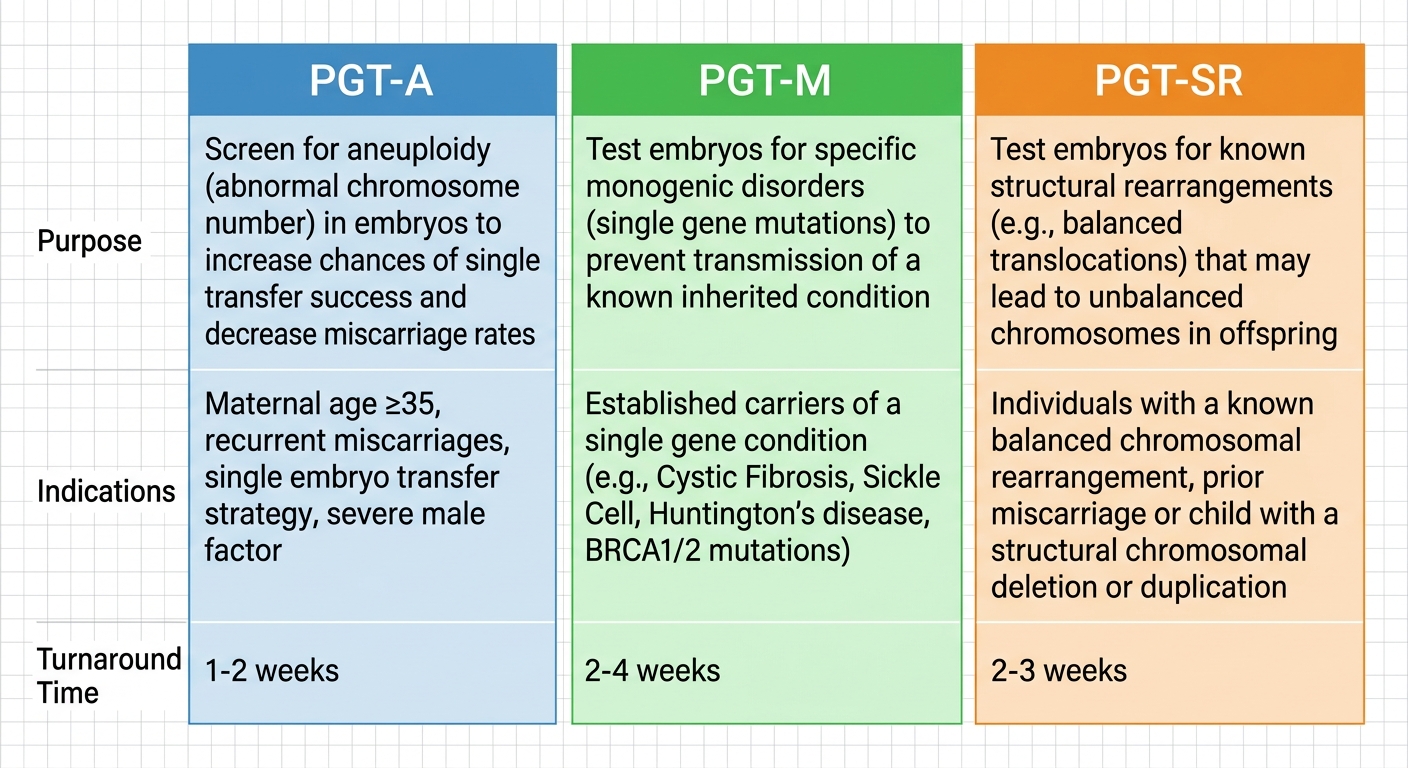
Side-by-side comparison of PGT-A, PGT-M, and PGT-SR genetic screening options.
PGT-A: Screening for Chromosomal Aneuploidies
Preimplantation Genetic Testing for Aneuploidy, or PGT-A, screens for missing or extra chromosomes--conditions called aneuploidies. Common aneuploidies include Down syndrome (trisomy 21), Edwards syndrome (trisomy 18), and Turner syndrome (monosomy X). Because the risk of chromosomal errors increases with maternal age, Preimplantation Genetic Testing PGT-A is often recommended for women over 35 and for couples with recurrent miscarriage or repeated implantation failure.
By identifying euploid embryos, this genetic screening can improve implantation rates and lower the chance of miscarriage, though it does not guarantee a pregnancy. According to RESOLVE, PGT-A helps rank embryos, and our team provides results within 5-10 days, guiding you with compassionate, patient-centric support in our warm and supportive setting.
PGT-M: Identifying Single-Gene Disorders
PGT-M identifies single-gene disorders in embryos for couples who are carriers or have a family history of conditions like cystic fibrosis, sickle cell disease, Tay-Sachs disease, or spinal muscular atrophy. This testing requires a custom probe, which can add 2-4 weeks before the IVF cycle.
PGT-M genetic testing IVF allows us to screen for these known mutations, greatly reducing the likelihood of passing on an inherited disease. RESOLVE emphasizes that while no test eliminates all risk, PGT-M offers meaningful risk reduction. After biopsy, results are available in 10-14 days, and our genetic counselors support you from probe development through interpretation, ensuring you feel informed and cared for.
PGT-SR: Detecting Structural Rearrangements
PGT-SR is intended for couples where one partner has a balanced chromosomal rearrangement, such as a translocation or inversion. These rearrangements can lead to unbalanced embryos that often miscarry or cause birth defects. By identifying embryos with normal or balanced chromosomes, PGT-SR helps our specialists select the healthiest options, supporting better outcomes.
The biopsy and turnaround time mirror PGT-M at 10-14 days. As with all PGT, results are used to inform decisions, not to promise success. Our team offers the emotional support you need throughout the process.
This information is educational and not a substitute for personal medical advice. Please consult your fertility specialist to determine which testing is right for you. Results vary based on individual circumstances.
What to Expect During Genetic Testing for Your IVF Cycle
Once you understand the purpose of genetic testing, it is helpful to know exactly what to expect during the process. When exploring Genetic Testing IVF in Miami, understanding each stage helps reduce uncertainty. For a comprehensive walkthrough, refer to our genetic testing guide fertility. At Elite IVF Solutions, we are devoted to providing personalized care and guiding you with clarity and compassion.
The Genetic Testing Process: From Biopsy to Results
We begin the genetic testing process on day 5 or 6 of embryo development, when the blastocyst has differentiated into distinct cell types. At this stage, our embryologist carefully removes 5-10 cells from the trophectoderm, the outer layer that will later form the placenta. This biopsy, performed under a microscope, does not disturb the inner cell mass that will become the fetus. According to Cleveland Clinic, the procedure is standard and adds no significant risk beyond that of a typical IVF cycle.
After the biopsy, the embryo is vitrified (frozen) while the biopsied cells are sent to a specialized genetics laboratory. The analysis proceeds as follows:
- Biopsy: Removal of 5-10 trophectoderm cells from the day-5 or day-6 blastocyst.
- Vitrification: The embryo is cryopreserved, remaining stable while the genetic analysis takes place.
- Genetic analysis: The laboratory examines the cells' chromosomes. For Preimplantation Genetic Testing PGT-A, the screen identifies missing or extra chromosomes. For PGT-M genetic testing IVF, the analysis targets specific single-gene mutations such as cystic fibrosis or sickle cell anemia.
- Results: PGT-A results are typically available in 5-10 days, while PGT-M may require 10-14 days (longer if a custom probe must be developed).
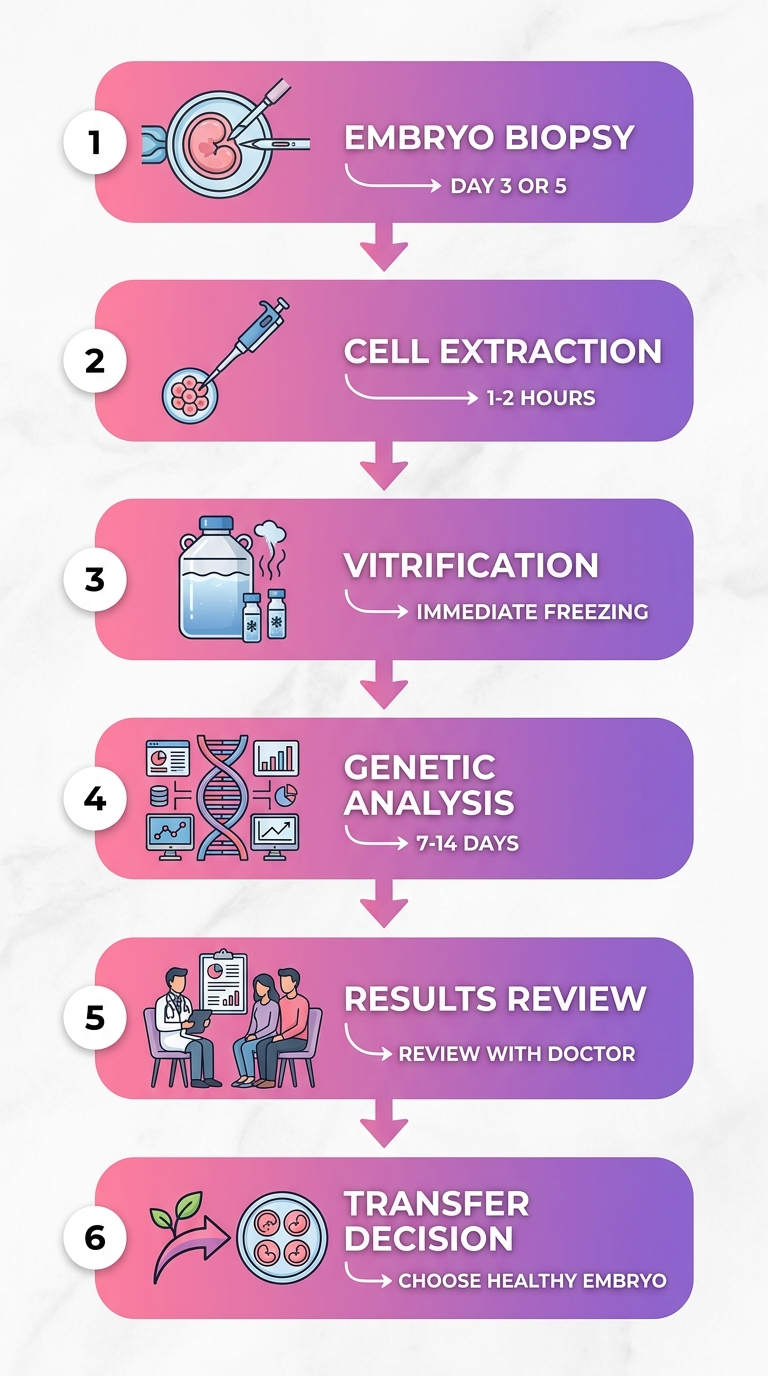
Step-by-step genetic testing process during an IVF cycle
Throughout this period, we maintain close communication with the lab and provide updates at key checkpoints. We understand that waiting for results can be emotionally challenging, and our team is here with emotional support every step of the way.
Cost and Insurance Considerations for Genetic Testing
The table below compares typical costs and turnaround times for the two main types of genetic testing.
| Factor | PGT-A | PGT-M |
|---|---|---|
| Average Cost per Cycle | $3,000 - $5,000 | $4,000 - $7,000 (may include probe development) |
| Turnaround Time | 5-10 days | 10-14 days (may take longer if new probe required) |
| Insurance Coverage | Rarely covered; some plans may cover with medical indication | May be partially covered for known genetic disorder carriers; check plan |
Based on typical clinic fee schedules and patient-reported estimates in South Florida.
The cost of Preimplantation Genetic Testing PGT-A typically ranges from $3,000 to $5,000 per cycle. For patients who require PGT-M genetic testing IVF, the cost may be $4,000 to $7,000, and it often includes the development of a custom probe for the family's specific mutation. Insurance coverage for these tests varies widely. PGT-A is rarely covered by standard health plans, though some policies may provide benefits if a medical indication is established. For PGT-M, coverage may be partially available for individuals known to be carriers of a severe genetic disorder. We encourage you to contact your insurance provider to verify your benefits, and our financial coordinator can help clarify any out-of-pocket responsibilities before treatment begins.
Interpreting Your Results and Genetic Counseling
Once the genetic analysis is complete, your results will be categorized as one of the following:
- Euploid: The embryo has the normal chromosome count and is most suitable for transfer.
- Aneuploid: The embryo has an abnormal number of chromosomes; transfer is typically not recommended because of the low likelihood of a healthy pregnancy.
- Mosaic: The embryo contains both normal and abnormal cells. After genetic counseling, some mosaic embryos may still be considered for transfer, as research suggests they can sometimes self-correct after implantation.
A genetic counselor will help you interpret these results and discuss the best course of action. Together we explore transfer options, recurrence risks, and any additional testing that might be helpful. Our team ensures you feel fully informed and supported in every decision. After reviewing costs and potential outcomes, our team will help you prepare for the testing procedure and coordinate with the genetics lab.
This information is provided for educational purposes and does not replace professional medical advice. Please consult your healthcare provider for guidance specific to your situation.
Genetic Testing for Recurrent Miscarriage and Hereditary Conditions
For those with recurrent miscarriage or a family history of genetic disorders, genetic testing adds a critical layer of information. At Elite IVF Solutions in Miami, we understand the emotional toll of repeated pregnancy loss. For individuals considering genetic testing IVF in Miami, understanding the options is essential. Preimplantation genetic testing (PGT) can identify chromosomal abnormalities and single-gene disorders in embryos created through IVF, helping to guide treatment decisions and potentially improve the chances of a successful pregnancy.
The most common chromosomal cause of early miscarriage is aneuploidy, where an embryo has an abnormal number of chromosomes. Preimplantation genetic testing, specifically PGT-A, screens for these whole-chromosome abnormalities before transfer. According to the American College of Obstetricians and Gynecologists (ACOG), PGT-A may help select chromosomally normal embryos, reducing the risk of miscarriage in some patients. While its routine use remains under debate, many couples with recurrent loss find value in this additional screening step.
When one or both partners carry a gene for a heritable condition--such as cystic fibrosis or sickle cell disease--PGT-M genetic testing IVF can identify embryos affected by the disorder. ACOG recognizes the established clinical utility of this testing for single-gene and chromosomal structural rearrangements. By identifying unaffected embryos, we can help parents reduce the risk of passing on a genetic condition. Unaffected embryos may be selected for transfer, often through a frozen embryo transfer procedure.
If you are considering genetic testing IVF in Miami, our team at Elite IVF Solutions provides comprehensive PGT services in a warm and supportive setting. We combine advanced technology with personalized care and emotional support, ensuring you understand every step of the process.
Genetic testing can provide valuable insights, though results are not guaranteed. Please note that the information provided here is educational and not a substitute for personal medical advice. Consult your healthcare provider for guidance specific to your situation. We are devoted to help you navigate your fertility journey with personalized, evidence-based options.
Frequently Asked Questions About Genetic Testing for IVF
Given the complexity of genetic testing, patients considering genetic testing for IVF in Miami often have further questions. We address the most common ones below.
What types of genetic testing can be done on embryos during IVF?
During the in vitro fertilization process, we perform PGT-A (preimplantation genetic testing for aneuploidy) for chromosomal screening, PGT-M genetic testing for single-gene disorders, and PGT-SR for structural rearrangements.
What is the difference between PGT-A and PGT-M?
PGT-A screens for extra or missing chromosomes, while PGT-M genetic testing diagnoses specific inherited conditions like cystic fibrosis. PGT-A is a screening tool, whereas PGT-M provides diagnostic accuracy for known mutations.
Are there risks to the embryo from the biopsy procedure?
The biopsy is performed on day-5 or day-6 blastocysts, sampling trophectoderm cells that will form the placenta, with minimal impact on viability. Genetic testing reduces the risk of transferring an affected embryo, and we use results to prioritize euploid embryos for transfer. However, no test can guarantee a healthy baby or predict future development. Individual testing recommendations should be discussed with your fertility specialist.
Empowering Your IVF Journey with Genetic Testing
For those exploring genetic testing IVF Miami, understanding how preimplantation genetic testing (PGT) works is a key step. Preimplantation genetic testing PGT-A screens embryos for abnormal chromosome counts, while PGT-M genetic testing IVF identifies single-gene disorders, as defined by the Cleveland Clinic. These advanced screenings allow us to select healthier embryos, potentially improving pregnancy outcomes, although testing is optional and discussed with our care team. We believe in personalized care and are devoted to help you navigate your fertility journey, but keep in mind that this educational content is not personal medical advice, individual results vary, and you should consult a healthcare professional.
This article was researched and written with the assistance of AI tools.